





















Expert appliance buying tips
Measure your needs and requirements
While it's important to know that an appliance has the functions and features you require, it's doubly important that you measure up and are sure that it fits in your home. So reach for your tape measure!
Kitchen appliances, such as fridges and dishwashers, often have to fit exactly spaces in cabinetry. And don't forget to ensure any appliance doors can open and close fully.
And while buying a huge television might seem like a good idea, ensure you can either hang it on a wall or position it at the correct level for comfortable viewing.
Even buying a stick vacuum cleaner requires careful consideration. Do you have a space close to a socket where it can charge unobtrusively? And does it come with a large docking station that you'll need to accommodate?
And, to state the obvious, measure to ensure any appliance you purchase is able to make it into your home in the first place, through a door, ranch slider or bifolds, especially if you live in an apartment.
Don't get sucked in by sales
Sales are a form of marketing, so don't take offers and deals at face value. If you're shopping for a new appliance, and you're able to take your time, track appliance prices from a range of retailers over a couple of months to ensure that any advertised price reductions are genuine.
Compare products, even between brands
Always thoroughly research appliance products, even those from the same brand. A manufacturer will often have different ranges produced to appeal to consumers across different price points.
Therefore a cheaper range from a major global brand might offer less quality and value for money than a top-of-the-range product from a less well-known or local brand.
Consider an appliance's long-term running costs
Most large whiteware purchases will last a decade. Therefore it's prudent to consider the energy and water consumption ratings of appliances such as washers, dryers, fridges and dishwashers.
Paying extra for a more energy- or water-efficient appliance could save you money, and boost your green credentials, over a decade of regular use.
You can read more on energy and water star ratings below.
Appliance energy star ratings explained
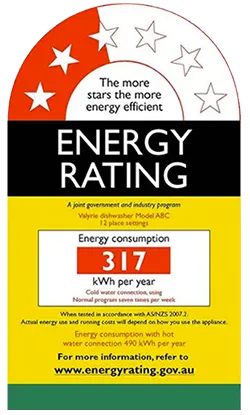
Energy star ratings are an initiative designed to help consumers work out an appliance's energy efficiency. They show an appliance's energy rating on a six- or 10-star scale, as well as its annual energy consumption (measured in kWh per year). Energy star ratings are mandatory for a number of household appliances, including dishwashers, washing machines, fridges and TVs.
Energy star ratings come in whole- or half-star increments. The rating is determined by energy service per unit of energy consumption, and the lower the energy consumption, the higher the star rating. Generally, you’ll see the standard six-star rating label.
Is a six-star energy rating the best?
When the energy star rating labels were first introduced, the highest efficiency rating an appliance could earn was six stars. In recent years, though, the ratings have been expanded, with super-efficient appliances now scoring between seven and 10 stars.
These super-efficient appliances have a slightly different label and are worth keeping an eye out for if you're after the most efficient appliances for your home.
Heat pump energy star ratings explained
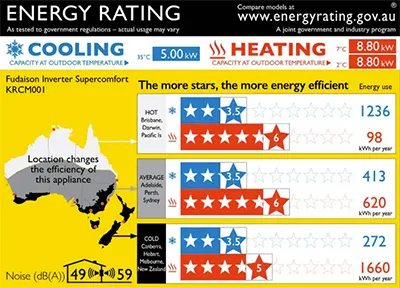
Heat pumps have blue-and-red Zoned Energy Rating Labels. The blue stars indicate how efficient the model is at cooling. The red stars show how efficient the heat pump is when heating.
The labels are standard across New Zealand and Australia, and the ratings are zoned to show more accurate efficiency, depending on three different climate zones.
How are energy star ratings calculated?
In New Zealand, the Energy Efficiency and Conservation Authority (EECA) administers label compliance.
The energy star ratings are determined by the size of the product and its energy consumption levels, and products are compared to similarly sized alternatives. This information is then used to create nationwide standards.
An appliance with a high energy star rating indicates that it does its job efficiently. This means that it generally uses less electricity than an appliance with a lower efficiency rating.
However, although this means that you should save money on your power bills, energy-efficient appliances are usually more expensive to purchase.
So it's a trade-off as to whether you want to save money upfront, by purchasing a less-efficient appliance, or save money in the long run by purchasing a more efficient product.
For example, let's compare two 420L fridges:
- Model 1 has a 2.5-star energy rating, costs $1299 to purchase and uses 468kW of energy per annum, with an approximate running cost of $117 per year.
- Model 2 has a 4-star energy rating, costs $1377 to purchase and uses 328kW of energy per annum, with an approximate running cost of $79.50 per year.
Although Model 1 may save you $78 in terms of its initial purchase cost, over a year it will cost you around $37.50 more in running costs.
If you go with Model 2, you will have made your money back after three years. And, assuming that your fridge lasts for the average lifespan of 14 years, you stand to save over $400 in terms of running costs and electricity bills over that period.
However, keep in mind this is a rough estimate, and the efficiency of each appliance will vary. As will the purchase price and the price paid for power. However, it does demonstrate that there are savings to found by purchasing energy-efficient appliances.
But remember, it's not all about savings. You may prefer paying more upfront to lower your monthly power bill, or you may just see value in reducing your carbon footprint.
How should I use the energy star ratings in my decision?
An energy star rating should be a key part of your buying decision. Not only will it future-proof your appliance, ensuring low ongoing costs, but an energy-efficient appliance is also good for the environment. While most of New Zealand's energy comes from renewable sources, using less energy is still beneficial.
However, make sure that when comparing energy star ratings you:
- Compare star ratings on appliances that are the same type, size and capacity.
- Use your home's power costs and average usage to get a better indication of annual running costs.
Appliance water star ratings explained
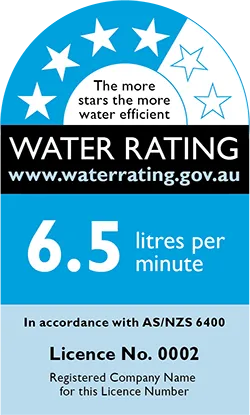
Appliances that use water, such as dishwashers and washing machines, feature water star ratings alongside energy star ratings. Other appliances (that don't use energy) such as showerheads and toilets may have a standalone water efficiency label.
The Water Efficiency Labelling Scheme uses a star rating to indicate an appliance's water efficiency and displays the machine's water usage in litres per minute.
If you're purchasing an appliance that uses both water and electricity, you'll have to consider its energy use and water use although, usually, appliances that are energy efficient are also water efficient.