





























Looking to invest your money in a term deposit? Here are some of the highest term deposit interest rates currently available on Canstar's database.
The results based on an investment of $25,000 for 12 months.
Best 6-month term deposit rates
The results based on an investment of $25,000 for 12 months.
Provider | 6-month rate |
|---|---|
Welcome | 4.00% |
Gold Band Finance | 3.90% |
General Finance | 3.80% |
Xceda Finance | 3.75% |
Rabobank | 3.70% |
Christian Savings | 3.65% |
ASB | 3.60% |
BNZ | 3.60% |
Kiwibank | 3.60% |
The Co-operative Bank | 3.60% |
AMP | 3.55% |
ANZ | 3.55% |
Heartland Bank | 3.55% |
SBS Bank | 3.55% |
TSB | 3.55% |
Unity | 3.45% |
Westpac | 3.45% |
Best 12-month term deposit rates
The results based on an investment of $25,000 for 12 months. The results based on an investment of $25,000 for 12 months.
Provider | 12-month rate |
|---|---|
General Finance | 4.55% |
Gold Band Finance | 4.50% |
SBS Bank | 4.50% |
Welcome | 4.40% |
Rabobank | 4.15% |
The Co-operative Bank | 4.10% |
Xceda Finance | 4.10% |
AMP | 4.05% |
BNZ | 4.05% |
Christian Savings | 4.05% |
Heartland Bank | 4.05% |
Kiwibank | 4.05% |
ANZ | 4.00% |
ASB | 4.00% |
Westpac | 4.00% |
TSB | 4.00% |
Unity | 3.35% |
Best 24-month term deposit rates
The results based on an investment of $25,000 for 12 months. The results based on an investment of $25,000 for 12 months.
Provider | 24-month rate |
|---|---|
Gold Band Finance | 4.85% |
General Finance | 4.80% |
Welcome | 4.80% |
Christian Savings | 4.50% |
Xceda Finance | 4.50% |
Rabobank | 4.45% |
The Co-operative Bank | 4.40% |
AMP | 4.35% |
BNZ | 4.35% |
Heartland Bank | 4.35% |
SBS Bank | 4.35% |
ANZ | 4.30% |
ASB | 4.30% |
Kiwibank | 4.30% |
Westpac | 4.30% |
TSB | 4.25% |
Unity | 3.55% |
Rate statistics, correct: October 16, 2026.
Term deposit overview
This graph shows the rates from the term-deposit providers on Canstar's database:
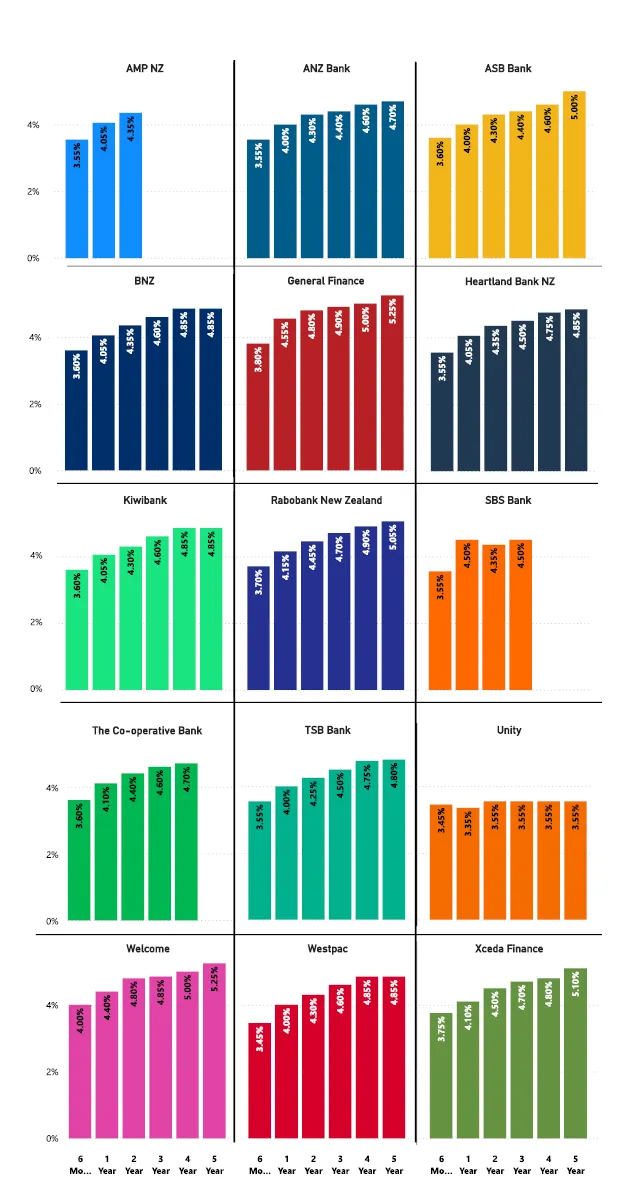
Rate statistics, correct: October 16, 2026.
Term deposits: things to consider
While a high interest rate is important, it isn’t the only factor to consider when looking for a term deposit. Some other factors you might want to keep in mind include:
Fixed time period
Choose your time wisely, because term deposits can be inflexible. For example, if you need to access your money before the end of the term, your bank may charge you a penalty fee and ask you to give them a period of notice.
Interest rates
They tend to vary a lot, depending on the provider and the term. As movements in both directions are possible, it pays to shop around.
Compound interest
Interest can be compounded at different frequencies, such as monthly, semi-annually and annually. The compounding frequency, the number of compounding periods and the interest rate will determine the amount of interest earned on a term deposit investment.
Often, you'll receive less interest on accounts that pay interest more regularly, for example monthly, due to the added benefits of compound interest.
Deposit size
Check whether there is any minimum amount needed to open a term deposit, and if a higher interest rate is offered for a larger amounts. It may be worthwhile depositing more than you originally considered to achieve a better rate.
Fees and charges
Are there any penalties or fees charged for early withdrawals?
Rolling over
As rates are constantly moving, it's important to be aware that if you roll over your account, you might be fixing at a lower (or higher) amount. Also be aware that sometime you can earn bonus interest if you agree to roll over your term deposit. So check with your provider to see what options you have, and what terms and conditions apply.
What happens if you withdraw a term deposit early?
When you sign up to invest in a term deposit, most financial institutions provide a cooling off period, from around seven working days to up to a month. During this period you can get your original funds back, no questions asked, and incur no penalty fees. However, you'll not earn any interest, either, which is fair enough.
However, should you want to get your hands on your funds after the cooling-off period has expired, conditions apply. Of course, the money is yours, and banks are unlikely to refuse to return your funds early. But they are entitled to recoup their administration costs and dock the amount of interest you earn.
Of the lenders in Canstar's term deposit database, each has their own Ts&Cs when it comes to the early withdrawal of term deposit funds. But, depending on the lender, you can usually expect an interest rate reduction of between 1%-3% p.a. Some lenders also charge an early termination fee, which could be up to $50.
Also, if you are suffering financial hardship, some banks allow you to get your hands on your funds quickly, but most require around a month's notice.
What is term deposit laddering?
Laddering is a strategy that involves an investor dividing their total investment sum and investing each part in separate term deposits with different maturity dates. Each deposit represents a "rung" on the ladder, with each rung having a different maturity date.
For example, if you have $10,000 to invest. Instead of investing the entire amount in a single term deposit, you might choose to create a laddering strategy like this:
- Invest $2000 in a 1-year term deposit.
- Invest $2000 in a 2-year term deposit.
- Invest $2000 in a 3-year term deposit.
- Invest $2000 in a 4-year term deposit.
- Invest $2000 in a 5-year term deposit.
As each term deposit matures, you can choose to reinvest the funds in a new term deposit with the longest maturity or use the funds for other purposes. This laddering strategy helps manage interest rate risk by providing regular access to a portion of the invested funds, allowing for potential reinvestment at different interest rate environments.
Benefits of laddering
The key advantage of laddering is that it provides a balance between liquidity and potentially higher interest rates for longer-term investments. It's a way to mitigate the risk of locking in funds at a low interest rate for an extended period, while still benefiting from the potentially higher rates associated with longer-term deposits.
Risks of laddering
While laddering can be a great investment strategy, like any financial approach, it comes with its own set of risks. Here are some potential risks associated with laddering:
- Interest rate risk: laddering exposes investors to interest rate risk. If interest rates fall significantly, the funds from maturing shorter-term investments may face reinvestment at lower rates, leading to missed opportunities for higher returns. Conversely, if rates rise, longer-term investments may remain locked in at lower rates.
- Lack of flexibility: while laddering provides some liquidity with regular maturing investments, it can also limit flexibility. If funds are needed unexpectedly, breaking a term deposit before maturity may result in penalties or reduced interest earnings.
- Inflation risk: longer-term investments might not keep pace with inflation. If inflation rates exceed the returns on the longer-term deposits, the purchasing power of the invested funds may decrease over time.
What is the Depositor Compensation Scheme?
The Depositor Compensation Scheme (DCS) is a government initiative that guarantees savers' money in the event that the financial institution holding their funds goes under. It protects up to $100,000 of savings per depositor, per deposit taker, in the event that the deposit taker gets into financial difficulty.

What does the depositor compensation scheme cover?
The DCS covers cash deposits in regular savings accounts, including:
- Current and savings accounts
- Notice accounts
- Term deposits
The DCS covers up to $100,000 of savings per depositor, per deposit taker. This means if you have savings of $200,000 spread equally across two financial institutions, your full $200,000 will be covered.
However, if you have $200,000 saved with one deposit taker, only $100,000 will be covered.
Although if you are a couple with a joint savings account with one provider, you each receive $100,000 of cover.
What doesn't the depositor compensation scheme cover?
The DCS doesn't cover investments such as stocks and shares, bonds and other managed investment products, including KiwiSaver.
One grey area is PIE Funds. The regulations state that certain PIE funds are covered, but only if they invest in the "protected deposits issued by a single licensed deposit taker”. For example, an NZ bank's PIE fund that invests only in the bank's own dollar deposits.
If you have any concerns about whether your choice of savings account or PIE fund product is covered by the DCS, just ask your provider.
To make things clearer for consumers, documentation for all PIE funds and other financial products covered by the DCS will be clearly marked with the DCS logo.
Which deposit takers are covered under the depositor compensation scheme?
The DCS covers all New Zealand banks, building societies, credit unions and finance companies that are either registered or licensed by the Reserve Bank of New Zealand to take deposits from customers.
This covers the major banks and financial institutions such as Xceda Finance and General Finance, two providers that offer the highest term deposit rates on Canstar's database.
For the full list of registered NZ banks click here.
For the full list of licensed non-bank deposit takers click here.
What are the benefits of the depositor compensation scheme?
For savers, the DCS offers peace of mind that their savings are secure. And because the DCS covers up to $100,000 per depositor, per deposit taker, savers can protect larger sums by splitting their money between different financial institutions.
The DCS also offers the opportunity to chase higher returns via non-bank deposit takers that have lower credit ratings than the major banks.
While most of the big banks enjoy AA- ratings, smaller deposit takers usually have credit ratings of around BB. While this is still good, it can deter savers looking to deposit large sums. The introduction of the DCS affords savers an extra level of protection.
If you're considering investing in a term deposit, you can access the up-to-date term deposit rates on Canstar's database by clicking on the button below.
PIE funds explained
A Portfolio Investment Entity (PIE) fund is a financial product that invests in low-risk, passive investments, such as a bank's deposit accounts.
A PIE, or term fund, acts exactly like a term deposit, offering a fixed rate of return over a set investment period. And just like a term deposit, there are usually no joining or management fees.
But there is one important point of difference between a PIE and a term deposit: any interest you earn from a PIE is taxed at your prescribed investor rate (PIR), instead of your personal income tax rate.
And, across the board, PIRs are a lot lower than income tax rates. These lower rates are called prescribed investor rates (PIRs):
Annual | Income | PIR |
$15,601-$53,500 | 17.5% | 10.5% |
$53,501-$78,100 | 30% | 17.5% |
$78,101-$180,000 | 33% | 28% |
$180,000+ | 39% | 28% |
If you're not sure about your PIR, it's easy to check, here at the IRD's site.
While financial institutions publish their PIE fund interest rates on their websites, they don't all display the effective tax rates on offer across their products. So to help you compare PIE funds and the effective interest rates on offer, Canstar has put together the following charts:
- 6-month term deposits
- 12-month term deposits
- 24-month term deposits
All the PIE funds listed below are covered by the RBNZ's Depositor Compensation Scheme, which provides insurance for deposits up to $100,000 per deposit taker.
Note: interest payment frequencies vary and minimum deposits may apply. Check financial institutions' websites for full details.
PIE fund rates: 6-month term
The chart below compares the institutions' 6-month PIE funds' rates with their effective interest rates.
| PIE Fund | Effective rate 30%* | Effective rate 33%** | Effective rate 39%*** |
|---|---|---|---|---|
ANZ | 3.60% | 3.70% | 3.87% | 4.25% |
ASB | 3.60% | 3.70% | 3.87% | 4.25% |
BNZ | 3.60% | 3.70% | 3.87% | 4.25% |
Kiwibank | 3.60% | 3.70% | 3.87% | 4.25% |
Heartland Bank | 3.55% | 3.65% | 3.81% | 4.19% |
Westpac | 3.45% | 3.55% | 3.71% | 4.07% |
PIE fund rates: 12-month term
The chart below compares the institutions' 12-month PIE funds' rates with their effective interest rates.
| PIE Fund | Effective rate 30%* | Effective rate 33%** | Effective rate 39%*** |
|---|---|---|---|---|
BNZ | 4.05% | 4.17% | 4.35% | 4.78% |
Heartland Bank | 4.05% | 4.17% | 4.35% | 4.78% |
Kiwibank | 4.05% | 4.17% | 4.35% | 4.78% |
ANZ | 4.00% | 4.11% | 4.30% | 4.72% |
ASB | 4.00% | 4.11% | 4.30% | 4.72% |
Westpac | 4.00% | 4.11% | 4.30% | 4.72% |
ANZ | 3.90% | 4.01% | 4.19% | 4.60% |
PIE fund rates: 24-month term
The chart below compares the institutions' 24-month PIE funds' rates with their effective interest rates.
| PIE Fund | Effective rate 30%* | Effective rate 33%** | Effective rate 39%*** |
|---|---|---|---|---|
BNZ | 4.35% | 4.47% | 4.67% | 5.13% |
Heartland Bank | 4.35% | 4.47% | 4.67% | 5.13% |
ANZ | 4.30% | 4.42% | 4.62% | 5.08% |
ASB | 4.30% | 4.42% | 4.62% | 5.08% |
Westpac | 4.30% | 4.42% | 4.62% | 5.08% |
Rate statistics, correct: October 16, 2026.
*Applies to investors with taxable income of $53,501 to $78,100.
**Applies to investors with taxable income of $78,101 to $180,000.
***Applies to investors with taxable income of $180,001+
PIE funds: things to consider
While a high interest rate is important, it isn’t the only factor to consider when looking for a PIE fund. Some other factors you might want to keep in mind include:
Fixed time period
Choose your time wisely, because term deposits can be inflexible. For example, if you need to access your money before the end of the term, your bank may charge you a penalty fee and ask you to give them a period of notice.
Interest rates
They tend to vary a lot, depending on the provider and the term. As movements in both directions are possible, it pays to shop around.
Compound interest
Interest can be compounded at different frequencies, such as monthly, semi-annually and annually. The compounding frequency, the number of compounding periods and the interest rate can determine the amount of interest earned on a term investment.
Deposit size
Check whether there is any minimum amount needed to open a term deposit, and if a higher interest rate is offered for a larger amounts. It may be worthwhile depositing more than you originally considered to achieve a better rate.
Fees and charges
Are there any penalties charged for early withdrawals or any other fees involved?
For a full rundown of all the up-to-date term deposit rates on Canstar's database, just click on the button below.