




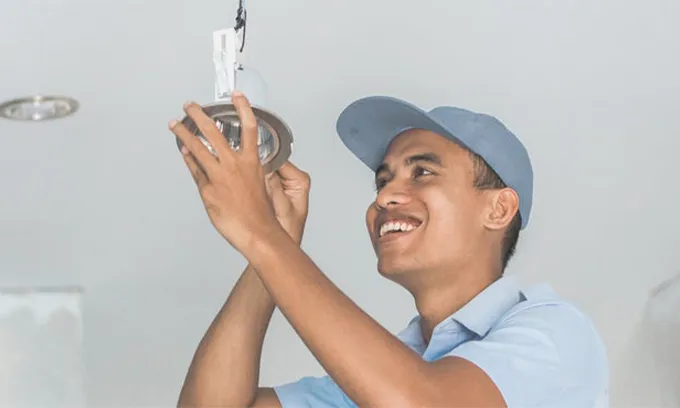
If you’re planning a home renovation, and want to install a light fixture or replace an old dirty switch, you might assume that it has to be the job of a professional. But not so fast.
If you're confident that you know what you're doing, you may be able to do the work yourself. Canstar Blue breaks down what electrical tasks are within the realms of DIY, and when the law requires you to call in the pros.
Lighting is an important feature in all homes. Not only is it an everyday essential, it can have a dramatic impact on a home's look and feel. And, compared with many makeover must-haves, it doesn't have to break the bank. Lighting fixtures and fittings come at price points to suit all budgets - it's just the cost of hiring a certified electrician that can be truly shocking!
However, the good news is that if you are confident that your are competent, it's not unlawful to undertake many smaller electrical jobs around the home yourself.
So what exactly can you do and what steps do you need to take to ensure safety at all time. Canstar Blue explores:
Install a light: basic electrical safety
Before you do any electrical work, there are a few important steps that you need to follow. You need to ensure that:
- You're confident you know what you're doing and have the necessary knowledge and skills
- The power is turned off at the mains
- Any device you're working on is unplugged
- You are not working where conductors or terminals are live or could become live
Install a light? What am I legally allowed to do?
According to the Electricity Act 1992, there are a few simple electrical tasks that you are allowed to do yourself. However, you must own and live in the property. So if you rent your home, or plan to do work as a landlord on your tenant's place, you'll have to employ a qualified electrician.
Plus, the work you're allowed to undertake yourself only applies to “low voltage electrical installations when there is no payment or reward”.
New Zealand regulations state that you can remove and replace any of the following kinds of electrical fittings, as long as the work does not involve a switchboard.
Install a light? Permitted work
- Replacing or repairing electrical switches, socket outlets, lamp holders, ceiling roses
- Replacing water heater switches, thermostats and elements
- Moving, repairing or replacing flexible cords that are permanently connected to outlets or ceiling roses
- Disconnecting and reconnecting permanently wired appliances
- Moving switches, sockets and lighting outlets (only if they are wired with tough plastic-sheathed cables)
- Installing, extending, or altering any cables, except the main cables that come from the street to your switchboard
- Fitting plugs, cord extension sockets or appliance connectors to a flexible cord
- Replacing fuse wires and fuse cartridges
For the more confident DIY sparky, the law does also permit a bit of home wiring. Although if you're installing, extending or altering cables, you're not allowed to connect your work to the electricity supply yourself.
The finished job has to be checked and tested by a licensed electrical inspector. If it complies with safety requirements, the inspector will connect it, test it, and issue you with a Certificate of Compliance.
Given the costs involved with getting a licensed inspector in, you're probably better off just getting the wiring done by a professional electrician in the first place.
Two electrical smart moves
While you're updating your electrical fixtures, it is a good time to think about:
- If your lighting is energy efficient
- Whether you're getting the best value electricity
Energy efficient lighting
Old incandescent bulbs and, even worse, halogen bulbs are terribly inefficient sources of light. Halogen bulbs are red-hot wasters of electricity, literally. Have you felt the heat those babies radiate? New Zealand is one of the few countries that has yet to ban incandescent bulbs, but that doesn't mean you need to continue to use them.
Modern LED bulbs are remarkably cheap, are compatible with all conventional fittings, last forever and burn up to 80% less power than incandescent bulbs. So what are you waiting for? Ditch those old bulbs now!
The best value electricity
When was the last time you reviewed how much you're paying for your power? Electricity providers in NZ change their pricing and plans all the time to stay competitive. So if you've been with the same provider for yonks, chances are there is a far better value deal out there for your home. You could potentially save hundreds of dollars a year by switching to a more competitive plan.
Take a look at your next power bill. Once you know how much you're paying in fixed and variable charges, it's easy to jump online and compare different power companies and the deals they're offering.